
No products in the cart.

Single-Ingredient Dog Treats vs “Single Protein” Dog Food: What’s the Difference?
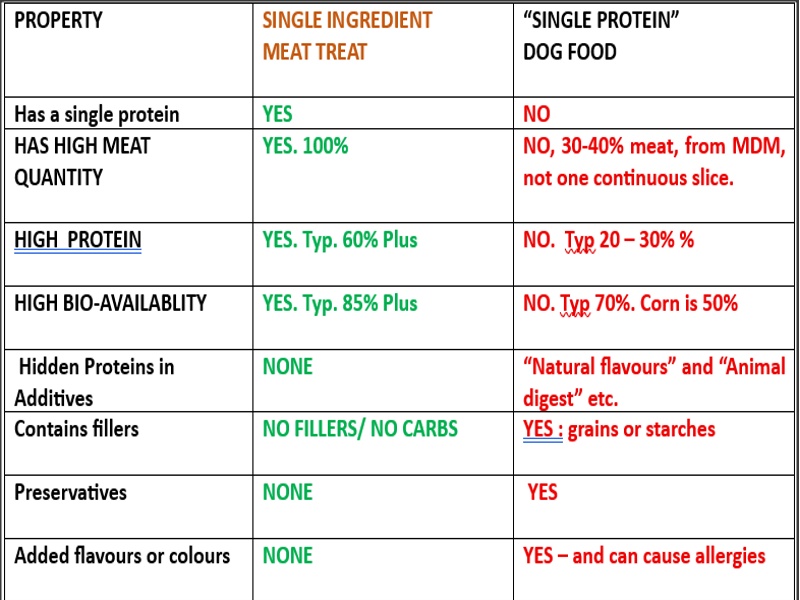
Have you ever looked at a bag of dog food labelled “single protein” and wondered exactly what that means?
It is a reasonable question.
The words single ingredient, single protein, natural and hypoallergenic can sound very similar, but they describe different things.
And when you’re choosing treats for your dog — particularly if your dog has food sensitivities or you simply want to know exactly what you’re feeding — the ingredient list matters.
At Healthy Dog Treats, we have always believed in keeping things simple wherever possible.
That is why so many of our treats are made from one animal ingredient and nothing else.
So let’s look at the difference between a genuinely single-ingredient treat and a dog food that is marketed as “single protein”.
What does “single ingredient” actually mean?
A single-ingredient treat is exactly what the name suggests:
One ingredient.
For example:
- 100% beef liver
- 100% kangaroo
- 100% chicken breast
- 100% fish skin
- 100% beef
- 100% lamb
There is no need to decode a long ingredient panel to find out what you’re actually buying.
If the packet says 100% kangaroo, the ingredient is kangaroo.
If it says 100% beef liver, the ingredient is beef liver.
That simplicity is one of the reasons single-ingredient treats are so appealing to dog owners.
You can see what you’re feeding your dog.
Why does a short ingredient list matter?
For many healthy dogs, a varied and nutritionally complete diet can be perfectly appropriate.
But there are situations where knowing exactly what is in a treat can be particularly useful.
For example, if your dog has experienced a food reaction or your veterinarian has recommended a restricted or elimination diet, keeping the number of ingredients you introduce can make it easier to identify potential problem ingredients.
It is important to point out that a treat is not the same thing as a complete and balanced dog food.
Treats are treats. They are intended to be fed alongside your dog’s normal diet, rather than replace it.
And if your dog has a diagnosed medical condition or is on a veterinary-prescribed diet, your veterinarian is the right person to advise which treats are appropriate.
But what does “single protein” mean?
This is where things become more interesting.
A dog food can be marketed around a particular animal protein — for example, chicken, lamb or salmon — while still containing a number of other ingredients.
Look at a typical ingredient list and you may find:
- an animal ingredient
- animal fats
- grains
- legumes
- vegetables
- starches
- fibres
- vitamins and minerals
- flavouring or other functional ingredients
That doesn’t automatically make the food bad.
In fact, a properly formulated complete and balanced dog food needs to provide the right balance of nutrients, and a number of ingredients may be used to achieve that. AAFCO notes that ingredients in complete and balanced pet foods work together to meet nutritional requirements, and ingredients are listed individually in descending order by weight.
The important point is simply this:
“Single protein” and “single ingredient” are not the same claim.
A food can have one prominently named animal protein while containing many other ingredients that contribute protein, fat, carbohydrates, fibre and other nutrients.
That’s why reading the complete ingredient list is more informative than relying only on the words printed prominently on the front of the packet.
Single ingredient vs single protein
Here’s the easiest way to think about it:
| Single-ingredient treat | “Single protein” dog food | |
| Number of ingredients | One | Can be many |
| Ingredient list | Very simple | Usually much longer |
| Animal ingredient | Clearly identified | Usually identified, but part of a larger formula |
| Other protein contributors | None, if genuinely one ingredient | VERY Likely to be present – depending on the formula |
| Main purpose | Treat/reward | Complete food, when formulated as such |
| What should you check? | The single ingredient | The entire ingredient list |
This is why we think there is real value in knowing exactly what is in your dog’s treats.
Don’t be fooled by the size of the words on the front
The front of a packet is designed to communicate quickly.
The ingredient list is where you find the detail.
AAFCO explains that pet-food ingredients are listed individually in descending order by weight. That means the ingredient list gives you much more information than simply looking at the product name or the biggest words on the front of the package.
So when you see:
“SINGLE PROTEIN CHICKEN”
don’t stop there.
Turn the packet over.
Read the ingredients.
Ask yourself:
What are the other ingredients?
That’s not about automatically deciding that a particular food is good or bad.
It’s about knowing what you’re buying.
Why we love single-ingredient meat treats
This is where single-ingredient treats have a very simple advantage:
You don’t have to guess.
If the ingredient says:
100% Kangaroo
you know what you’re getting.
If it says:
100% Beef Liver
you know what you’re getting.
If it says:
100% Chicken Breast
you know what you’re getting.
There is something reassuring about that simplicity.
And for dogs, single-ingredient treats can also be incredibly useful for training because the owner knows exactly what ingredient they’re rewarding with.
What about offal?
Some of the most interesting single-ingredient treats are made from organ meats, often called offal.
Liver, heart and kidney are all animal tissues with different nutritional profiles.
For example, liver is well known as a source of vitamin A and several B vitamins, while heart provides protein and other nutrients.
But, as with any treat, more is not necessarily better.
Organ meats and treats should be fed appropriately as part of the dog’s overall diet rather than treated as a complete nutritional replacement for balanced dog food.
What about carbohydrates?
This is an area where there is a lot of confusion online.
Dogs can digest and use carbohydrates, and carbohydrates can provide energy and other nutrients.
The more useful question isn’t simply:
“Are carbohydrates good or bad?”
It is:
“What is actually in my dog’s food, and why is it there?”
A well-formulated complete dog food is designed to meet nutritional requirements using a combination of ingredients.
You should note that Carbs actually mean the SUGAR Component. And that While this is just one of the ingredients in any plant matter, that plant protein tends to be much less than most meat protein (as % of the total) AND it is less bio-available – meaning you need more of it, to provide the same absolute protein level as meat.
But rather than demonising one particular ingredient category, we think dog owners are better served by understanding the whole ingredient list.
That’s a much more useful way to look at pet food.
“Natural” doesn’t automatically mean better either
The same principle applies to the word “natural.”
Natural sounds reassuring — but the word itself doesn’t tell you everything you need to know about a product.
AAFCO has a specific definition of “natural” for pet-food labelling, and the term still needs to be considered alongside the actual ingredient list and nutritional purpose of the food.
So don’t buy a product simply because the front says:
NATURAL
Instead, turn the packet around.
Read the ingredients.
So what’s the real advantage of a single-ingredient treat?
For us, it comes down to simplicity and transparency.
You don’t need to understand a complicated formula.
You don’t need to interpret twenty different ingredients.
You don’t need to wonder what flavourings or other ingredients have been added.
If you’re giving your dog:
100% kangaroo
then you know you’re giving your dog kangaroo.
If you’re giving your dog:
100% beef liver
then you know you’re giving your dog beef liver.
That’s the reason we have built so much of Healthy Dog Treats around single-ingredient treats.
BUT more than that. If you know a type of meat (like beef) is safe for your dog. Then you know 100% single ingredient beef is SAFE for your dog. You also know that they are getting maximum useable protein for all of the functions that their body needs quality protein for.
And there’s another important point: treats are still treats
It’s to use good-quality treats sensibly:
- as rewards
- during training
- as occasional snacks
- as part of enrichment
- and simply because your dog deserves something tasty.
If your dog has a medical condition, dietary sensitivity or is eating a veterinary-prescribed diet, check with your veterinary team before introducing treats.
What we believe at Healthy Dog Treats
We don’t think every commercial dog food is bad. And we don’t think every ingredient that isn’t meat is bad.
Dogs need a properly balanced diet, and complete dog foods are specifically formulated to provide the nutrients dogs need.
What we do believe is that dog owners deserve to know what they’re buying.
When it comes to treats, there’s no reason to make things complicated.
A single-ingredient treat gives you an exceptionally simple ingredient list:
One ingredient.
That’s it.
And when you pick up a bag of Healthy Dog Treats, that’s exactly what we want you to be able to understand.
You can look at the packet and know what you’re giving your dog.
The bottom line
The next time you see “single protein” on a bag of dog food, don’t automatically assume it means “single ingredient.”
And dont automatically believe that their is only a SINGLE protein in that bag. (remember all plants provide a some protein too)
They’re different concepts.
Look at the whole ingredient list.
Understand what you’re buying.
And when it comes to treats, if simplicity is what you’re looking for, a genuine single-ingredient treat makes that choice very easy.
One ingredient.
One clearly identified animal source.
Nothing unnecessary added.
That’s why we love them.
And that’s what Healthy Dog Treats has been doing since 2011.